
By Hana · Last updated: 27 October 2026
A high-protein shake in a portable blender takes about a minute: pour in 200–250ml of milk or water, add one scoop of protein powder, then fruit, oats or yogurt, and a few small ice cubes last. Blending with liquid first stops clumps, and adding fruit or oats makes it more filling.
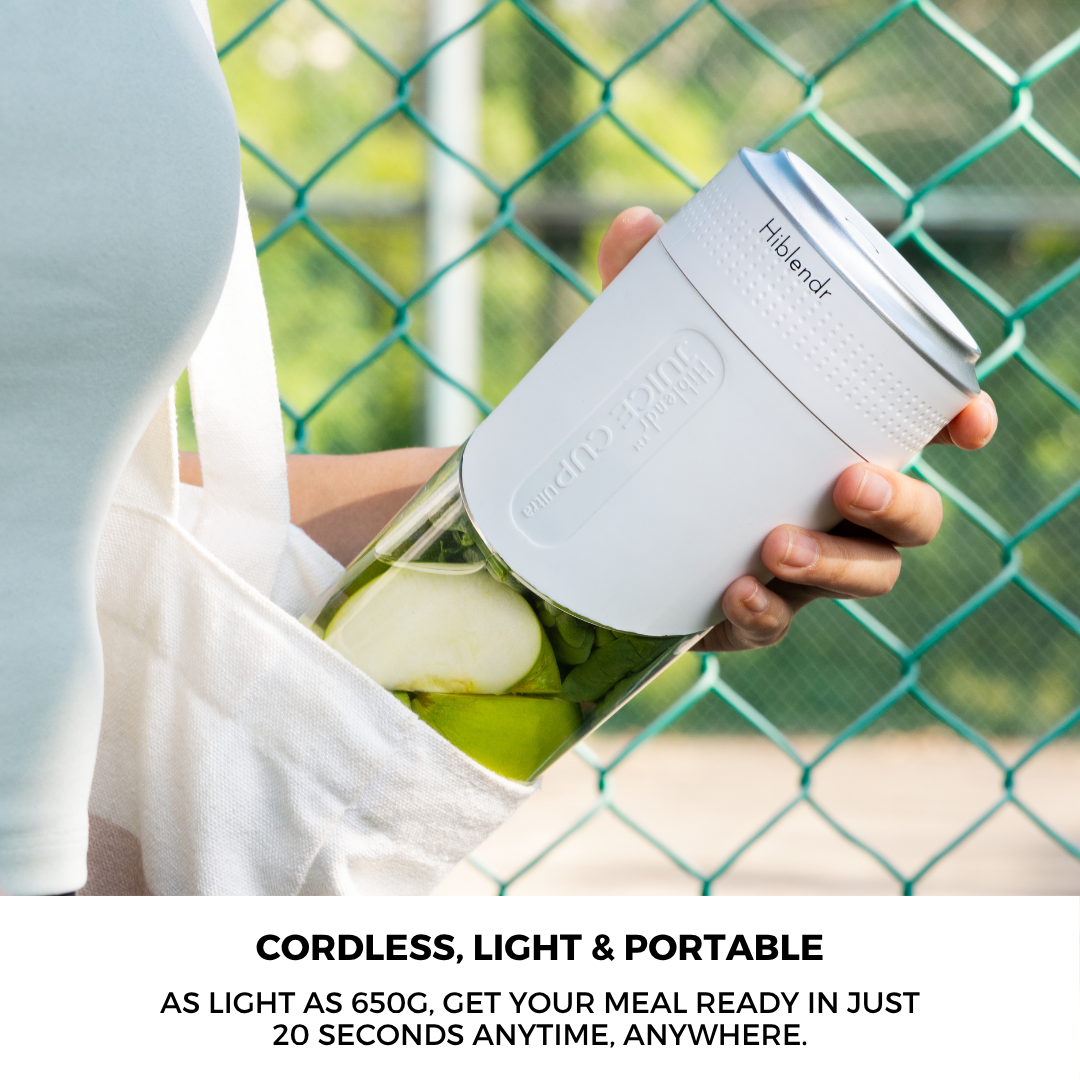
More smoothies and the 500ml cup rules: portable blender smoothie recipes. Hiblendr makes the Juice Cup Ultra, and every recipe below is measured for its 500ml cup.
Key takeaways
- Liquid first, powder second, ice last.
- Use one scoop as listed on your tub's label; scoop sizes differ between brands.
- Fruit, oats or yogurt make a shake more filling than powder and water alone.
- Rinse the cup within about 30 minutes. The Juice Cup Ultra is IPX6: rinse under the tap, never soak.
Three terms used here
- Scoop / serving: the amount listed on your protein powder label. Check it, because tubs differ.
- Whey / plant protein: milk-based powder vs powders made from pea, soy or rice.
- Portable blender: a cordless, USB-C rechargeable blender you drink from.
How do you make a protein shake without clumps?
Pour the liquid in first, then the protein powder, then thicker add-ins like yogurt, peanut butter or soaked oats, and fruit or ice last. That order lets the blades reach liquid straight away so powder doesn't stick to the bottom. If clumps remain, add a splash of liquid, tilt the cup and blend again.
- 200–250ml liquid (milk, soy milk, water, coconut water or cooled coffee).
- One scoop of protein powder.
- Yogurt, a teaspoon of peanut butter or soaked oats.
- Fruit, cut into small pieces.
- 2–3 small ice cubes or frozen fruit, last.
Blend, pause, tilt the cup and blend again if needed. Keep the total to about 400–450ml so the shake has room to move.

Portable blender vs shaker bottle: which is better for shakes?
For powder and water only, a shaker bottle is enough. It's cheaper, lighter and never needs charging. A portable blender is better once you add banana, frozen fruit, oats, ice or peanut butter, which a shaker can't break up. It also gives a smoother shake with fewer powder clumps.
| Shaker bottle | Portable blender (e.g. Juice Cup Ultra) | |
|---|---|---|
| Powder + water or milk | Yes | Yes |
| Banana, frozen fruit, ice | No | Yes, with enough liquid and small pieces |
| Oats, peanut butter, yogurt | Partly (stays lumpy) | Yes, in small amounts |
| Needs charging | No | Yes: USB-C, up to 20 blends per charge (Juice Cup Ultra) |
| Weight | Usually lighter | Juice Cup Ultra about 650g |
| Price | Usually cheaper | Juice Cup Ultra RM329 (27 Oct 2026) |
| Cleaning | Rinse | Rinse under the tap; the Juice Cup Ultra is IPX6, never soak |
If you only ever mix powder with water, keep your shaker. If you want breakfast-style shakes with fruit and oats, a blender earns its place. More on that trade-off: are portable blenders worth it?

How much protein is in each shake?
Most of the protein comes from your powder, so the honest answer is: check your powder label. Scoop sizes and protein per scoop differ between brands, so we haven't put a single number on each shake. Milk adds its own protein: MyFCD lists low-fat UHT milk at 2.96g per 100ml, so 250ml adds about 7g.
| Shake | Main protein sources |
|---|---|
| Vanilla mango | Powder + 250ml milk |
| Kopi protein | Powder + 150ml milk |
| Berry Greek yogurt | Powder + 200ml milk + 100g Greek yogurt |
| Banana oat breakfast | Powder + 250ml milk + oats |
| Pisang kurma | Powder + 250ml milk |
| Papaya lime whey cooler | Powder only (water base) |
| Soy milk chocolate | Plant powder + 250ml soy milk |
| Green protein | Powder + 200ml milk or soy milk |
| Peanut butter cocoa | Powder + 250ml milk + 1 tsp peanut butter |
| Coconut water | Powder only (coconut water base) |
To work out your total, add the protein per serving on your powder label to the milk (about 3g per 100ml, MyFCD), plus the labels of any yogurt, soy milk or peanut butter you use. Water and coconut water add little, so those two shakes rely on the powder.
10 high-protein shake recipes
Each recipe serves one and comes to about 400–450ml. "1 scoop" means one serving as listed on your tub. The hub already has a chocolate banana shake and a peanut butter oat shake: find them in the hub's protein section.

1. Vanilla mango protein shake
A thick, sweet shake that tastes like a mango lassi.
Ingredients:
- 250ml cold milk
- 1 scoop vanilla protein powder
- 100g frozen mango, in small cubes
Steps:
- Pour in the milk, then the powder.
- Add the frozen mango last.
- Blend, pause, then blend again until smooth.
Tip: Fresh mango works too; add 2 small ice cubes for a colder shake.
2. Kopi protein shake
Your afternoon kopi and protein in one cup.
Ingredients:
- 100ml coffee, cooled
- 150ml cold milk
- 1 scoop chocolate or vanilla protein powder
- 3 small ice cubes
Steps:
- Brew the coffee and let it cool completely.
- Pour in the coffee and milk, then the powder.
- Add the ice last and blend.
Tip: Never blend hot coffee. More coffee ideas: blender kopi recipes.
3. Berry Greek yogurt shake
Tangy, creamy and a little more filling thanks to the yogurt.
Ingredients:
- 200ml cold milk
- 1 scoop vanilla protein powder
- 100g Greek yogurt
- 80g frozen mixed berries
Steps:
- Pour in the milk, then the powder.
- Add the yogurt, then the berries.
- Blend, tilt and blend again.
Tip: Add a splash more milk if it's too thick to pour.
4. Banana oat breakfast protein shake
A two-minute breakfast for busy weekday mornings.
Ingredients:
- 250ml cold milk
- 1 scoop protein powder
- ½ banana, sliced
- 2 tbsp rolled oats
Steps:
- Soak the oats in the milk in the cup for 10 minutes.
- Add the powder, then the banana.
- Blend until smooth.
Tip: Soak the oats overnight in the fridge to save time in the morning.
5. Pisang kurma protein shake
Banana and dates give natural sweetness with a local twist.
Ingredients:
- 250ml cold milk
- 1 scoop vanilla protein powder
- ½ banana, sliced
- 2 pitted dates, soaked for 10 minutes
Steps:
- Soak the dates in a little warm water, then drain and let them cool.
- Pour in the milk, then the powder.
- Add the dates and banana and blend well.
Tip: Chop the dates small so they blend evenly.
6. Papaya lime whey cooler
Light and refreshing for a hot afternoon.
Ingredients:
- 200ml cold water
- 1 scoop unflavoured or vanilla whey
- 100g papaya, seeds removed
- A squeeze of lime
- 2 small ice cubes
Steps:
- Pour in the water, then the powder.
- Add the papaya and lime, then the ice.
- Blend until smooth.
Tip: Use ripe papaya for sweetness without added sugar.
7. Soy milk chocolate shake (plant-based)
A dairy-free option for plant protein users.
Ingredients:
- 250ml unsweetened soy milk
- 1 scoop chocolate plant protein
- ½ frozen banana, in small pieces
Steps:
- Pour in the soy milk, then the powder.
- Add the frozen banana last.
- Blend, pause and blend again.
Tip: Plant powders can be thicker; add 30–50ml more soy milk if needed.
8. Green protein shake
A mild green shake where the fruit hides the spinach.
Ingredients:
- 200ml milk or soy milk
- 1 scoop vanilla protein powder
- A small handful of spinach
- ½ banana
- 60g pineapple, in small pieces
Steps:
- Pour in the milk, then the powder.
- Add the spinach, banana and pineapple.
- Blend until no green flecks remain.
Tip: Tear the spinach into small pieces first.
9. Peanut butter cocoa shake (light)
A chocolatey treat with just a little peanut butter.
Ingredients:
- 250ml cold milk
- 1 scoop chocolate protein powder
- 1 tsp soft peanut butter
- 1 tsp cocoa powder
- 2 small ice cubes
Steps:
- Pour in the milk, then the powder and cocoa.
- Add the peanut butter, then the ice.
- Blend, tilt and blend again.
Tip: Keep it to a teaspoon or two of soft peanut butter; a big spoonful can stick to the blades.
10. Post-gym coconut water shake
A lighter, fruity shake for after training.
Ingredients:
- 250ml coconut water
- 1 scoop vanilla protein powder
- 80g frozen pineapple, in small pieces
Steps:
- Pour in the coconut water, then the powder.
- Add the frozen pineapple last.
- Blend until smooth.
Tip: Chill the coconut water first so you need less ice.
Can I take a protein shake for breakfast?
Yes, many people do, and adding fruit, oats or yogurt makes it more filling than powder and water alone. A shake of milk, one scoop of protein, half a banana and soaked oats takes about two minutes. Check your powder's serving size, and ask a doctor or dietitian if you have specific health needs.
Try the banana oat breakfast shake above, or the berry Greek yogurt shake if you prefer something tangier.
Prepping shakes for the gym or office
It's best to blend shakes fresh, because they separate and thicken as they sit. To save time, measure powder into a small container and blend at the gym or office; a USB-C portable blender like the Juice Cup Ultra charges on the go. For two servings, blend a batch in a 2L jug.
- Pre-measure: one scoop per small container, ready to tip in.
- Charge once: the Juice Cup Ultra lasts up to 20 blends per full charge, with USB-C charging.
- Batch for two: the HiJug Max (RM129, 2L) turns into a bigger blender with a lid swap on your Juice Cup Ultra base (base sold separately). Drink both servings fresh.
- Carry it: the Blendpack Insulated Sleeve (RM49) is a carry bag for the Juice Cup Ultra.
For water during training, see our guide to the 2L water bottle for the gym.

Cleaning protein residue from a portable blender
Rinse it within about 30 minutes, before the protein dries sticky. Blend warm water with a drop of dish soap, pour it out, then rinse the cup and blades under running water and dry with the lid off. The Juice Cup Ultra is IPX6, so rinse it under the tap but never soak or submerge it.
For dried-on residue around the blades, the HiBrush (RM39) cleaning kit fits the Juice Cup Ultra.
Juice Cup Ultra: the blender these were measured for
We measured every shake for the Juice Cup Ultra, now RM329 (usual price RM459). Its 500ml Tritan BPA-free cup has measurement markings, so you can pour 250ml of milk without a jug. The 240W motor and six stainless steel blades crush ice and frozen fruit when there's enough liquid. It lasts up to 20 blends per full charge, charges by USB-C and rinses clean under the tap (IPX6). It has 4.9 stars from 1,270 reviews, won the Red Dot Award: Product Design 2025, and Hiblendr is trusted by 60,000+ customers. As one reviewer, Teik, put it: "Been making my protein shakes with fruits everyday!"

Frequently asked questions
How much protein powder should I put in a shake?
Use the serving on your tub's label; scoop sizes and protein per scoop differ between brands. One scoop in 200–250ml of liquid is a typical starting point for a 500ml portable blender. Add more liquid, not more powder, if it's too thick.
Can a portable blender blend ice and frozen fruit for shakes?
Yes, with enough liquid and small pieces. Hiblendr's guidance for the Juice Cup Ultra is to cover ice or frozen fruit with liquid and keep pieces small. Icy shakes use more battery than soft fruit, so you'll get fewer blends per charge.
Can I use water instead of milk?
Yes. Water gives a lighter shake with less protein, since milk adds its own (MyFCD lists low-fat UHT milk at about 3g protein per 100ml). Soy milk is a plant-based option. Check the label of whatever you use for the numbers.
Can I put peanut butter in a portable blender?
A teaspoon or two of soft peanut butter blends fine with plenty of milk. A portable blender isn't made for making nut butter or blending thick pastes, so keep amounts small and add the liquid first.
Can I blend hot milk or coffee for a protein shake?
No. Let hot drinks cool first. Blending hot liquid in a sealed cup can build pressure and cause burns. Use cooled coffee or cold milk.
How many protein shakes can I make on one charge?
The Juice Cup Ultra is rated for up to 20 blends per full charge, and a full USB-C charge takes a little over 2 hours. Shakes with ice or frozen fruit use more power, so expect fewer.
Sources
- Hiblendr, Juice Cup Ultra (3rd Gen) product page: price, specs, IPX6 care, reviews (checked 27 Oct 2026).
- Hiblendr, HiJug Max, Blendpack Insulated Sleeve and HiBrush product pages (checked 27 Oct 2026).
- Red Dot, Hiblendr Juice Cup Ultra, Red Dot Award: Product Design 2025.
- Ministry of Health Malaysia / IMR, MyFCD: Milk, UHT, low fat (R111048), 2.96g protein per 100ml.

Leave a comment
This site is protected by hCaptcha and the hCaptcha Privacy Policy and Terms of Service apply.